Tuesday, August 18, 2009

Old Testament Narratives

Chapter 5 Notes of How to Read the Bible for All Its Worth

Over 40% of the Old Testament is narrative, meaning it's stories. They are purposeful stories retelling the historical events of the past that are intended to give meaning and direction for a given people in the present. The consist of your typical characters, plot, and plot resolution. The story being told can be seen of three levels:

Third (top) level - the metanarrative, or the whole universal plan of God worked out through His creation (e.i., creation, fall, sin, need of redemption, Christ incarnation and sacrifice)
Second level - the story of God's redeeming a people for His name (e.i., call of Abraham, enslaving of Israel, exile)
First level - the individual narratives that make up the other two levels (e.i., Joseph, Jacob, Esau)

Often the struggle is not what are narratives, but what they are not. Here are a few examples:

- Narratives are not allegories or stories filled with hidden meanings
- Narratives are not intended to teach moral lessons, but are given to show the progress of God's history of redemption
- Narratives are not lessons to follow; Just because someone did something in a Bible story doesn't mean you either have the permission or obligation to do it too

The Epistles

Chapter 3-4 Notes from How to Read the Bible for All Its Worth

The "ease" of interpreting epistles can be quite deceptive. Although inspired by the Holy Spirit and thus belonging to all time, they were first written out of the context of the author to the context of the original recipients. An issue we have is that the epistles are often written in response to something; so, we have the answers, but don't necessarily know the questions or problems. Another thing to note is that they were not written as encompass all Christian theology, but instead always theology applied to or directed toward a particular need.

Historical context - first thing is to try and reconstruct the original situation
Literary context - try to learn to trace the author's argument throughout the text

Often the hermeneutical challenge exists with what is cultural and therefore belongs to the first century alone and what transcends culture and is thus a Word for all seasons. To often we try to sneak around texts that don't make sense, rather than asking the right questions as to what it means.

Basic Rule - A text cannot mean what it never meant to its original audience (doesn't always help find out what text means, but helps find out what it doesn't mean)
Second Rule - Whenever we share comparable particulars (i.e., similar specific life situations), we can directly relate commands/text. If no comparable particulars exist, you must transfer the principle behind the text.

The Basic Tool: A Good Translation

Chapter 2 Notes from How to Read the Bible for All Its Worth


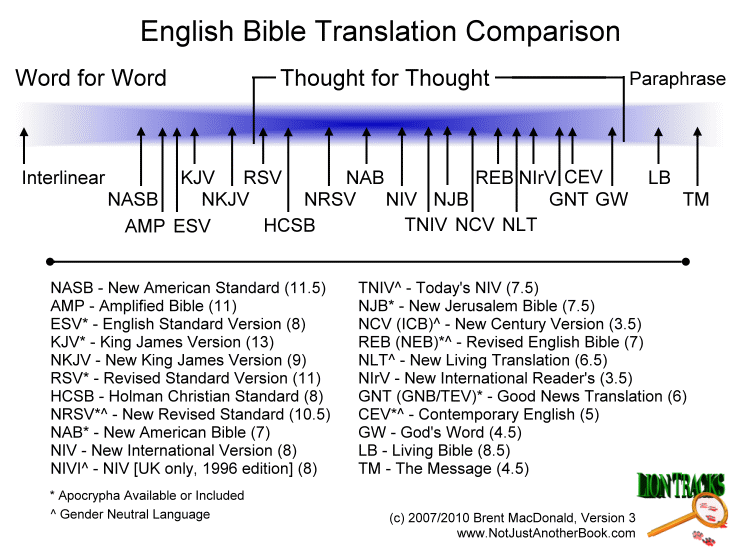
Obviously, the Bible was not originally written in English, so it has to be translated. Many make the downfall of trusting in only one translation. However, for the study of the Bible, you should use several well-chosen translations, knowing the strengths and weaknesses of each.

Historical distance - the difference that exists between the original language and receptor language
Formal equivalence - attempt to keep as close to the "form" of original language (literal, word for word)
Functional equivalence - attempt to keep as close to the "meaning" of original language (thought for thought)
Free translation - attempt to simply translate ideas, without less concern of exact words

Anyone who deals with multiple languages knows the difficulty of translations, i.e. euphemisms, idioms, vocabulary, wordplays, and matters of gender... All Bibles English-speakers use today are a product of translation, and thus deal with all these issues.

The Need to Interpret

Chapter 1 Notes from How to Read the Bible for All Its Worth

The Need to Interpret
Some people will often remark, "You don't have to interpret the Bible; just read it and do what is says!" Though there is some truth to that statement, as generally most people don't have trouble understanding Biblical principles, but instead struggle with putting it into practice. However, that statement is also false, as you often can't take the Bible at face value.

- The aim of good interpretation is not uniqueness, as unique interpretations are often wrong. Instead the aim is simple, to interpret the plain meaning of the text.

- The problem with us as readers is that we tend to believe our understanding is the same thing as the Holy Spirit/author's intent. However, everyone brings to the text all that they are, with their past knowledge, experience, culture, and so forth. So, whether people like it or not, they are always in the process of interpreting.

- Your Bible, whatever translation you use, as your BEGINNING point is actually the END RESULT of much scholarly work

- People can often interpret the "plain meaning" of the text to simply be what they desire that meaning to be, in order to justify or support their ideas

- The antidote to bad interpretation is not no interpretation, but good interpretation

- Much like the nature of Christ, the nature is Scripture is both human and divine - it has eternal relevance yet is given at a specific time, so it has historical particularity (conditioned by language, culture, and time of origin).

Step 1 - Exegesis
Exegesis - the careful, systematic study of the Scripture to discover the original, intended meaning (to hear what the original hearers heard)

-To make a text mean something God did not intend is to abuse the text, not use it.

-Good exegesis is to learn to read the text carefully and to ask the right questions of the text.

-Keys for good questions: context and content

Historical context - time, culture, politics, etc., figuring out the occasion an purpose of text
Literary context - placement in text, how it fits with the overall point of arguement
Content - definitions of words, grammatical relationships, etc.

Step 2 - Hermeneutics
Hermeneutics - how to apply these biblical principles to daily life today (how's does this apply to me?)

Friday, July 3, 2009

CONSENSUS

An exert from Team Fusion Blog

----------

There are multiple methods for making a decision such as a team vote, one person decides (best used in an emergency situation), or by a subgroup of the team (such as experts). Today, I will focus on the one method most often used by teams…CONSENSUS.

What is Consensus?
• Everyone understands the decision and can explain why it is best.
• Everyone can live with the decision.
• Everyone discussed the issue and took all sides into consideration.
• Everyone expressed their current viewpoint and answered questions posed by the team.

What is NOT Consensus?
• Everyone getting what they want.
• Everyone agreeing to a compromise.
• Everyone agreeing to a unanimous vote.

Consensus Works Best When…
• Decisions are important and affects many people.
• The team has 10 or fewer members.
• The team has lots of ideas to exchange whether in person, by phone, or video conferencing.

TOP TIPS FOR SUCCESSFUL CONSENSUS

1. Listen carefully. Be open and watch your assumptions about what is being said. Ask for the speakers’ reasons if you are unclear.
2. Encourage all team members to contribute. Silence does not necessarily mean the person agrees. Go around the circle and have each team member state their viewpoint.
3. Diligently search for options that meet the goals of the team. Don’t think in terms of “winning” or “losing.” When there is a disagreement, look for the next best alternative for everyone.
4. Don’t change your mind only to avoid conflict.
5. Don’t argue only for your position. Can your idea be combined with someone else’s?
6. Allow enough time to come to consensus. Here is the down-side to consensus…it takes time. Since everyone is expressing their opinion and everyone on the team needs to agree with the decision, the meeting should be long enough to give each person the opportunity to speak and ask clarifying questions.

Other than additional time, consensus requires the team to be skilled in communication, conflict resolution, facilitation, creative thinking, and open-mindedness. The up-side of coming to consensus is the high degree of trust and understanding created among the team members.

Friday, June 26, 2009

The Evil of Religion

"The idolatry of your rules is keeping you from seeing what God is doing right in front of your face."
- Greg Boyd


My brother-in-law, being the good-looking stud that he is, shared with me this sermon. Arguably one of the best sermons I've ever heard in regards to how following Christ is not religion, because "in religion rules trump love for others."

Tuesday, June 23, 2009

Readers are Leaders

"Leaders are readers."
- Unknown


John Maxwell says that an organization won't be able to rise above its leader's leadership capacity. If a leader is growing, the organization grows. And growing comes from learning, and a good source of learning is books (from what I'm told).